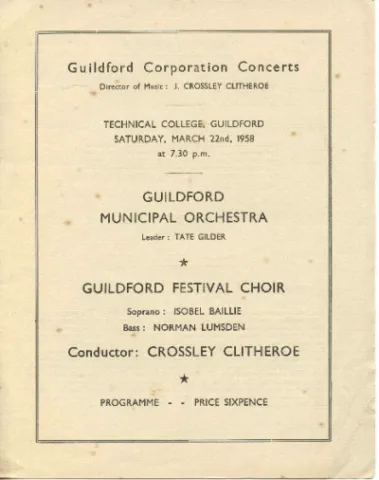
Guildford
E
Corporation
Concerts
Director of Music: J. CROSSLEY CLITHEROE
TECHNICAL COLLEGE, GUILDFORD
SATURDAY, MARCH 22nd, 1958
at 7.30 p.m.
GUILDFORD
MUNICIPAL ORCHESTRA
Leader: TATE GILDER
*
GUILDFORD FESTIVAL (_:HOIR
Soprano: ISOBEL BAILLIE
Bass:
NORMAN LUMSDEN
Conductor: CROSSLEY CLITHEROE
*
PROGRAMME - - PRICE SIXPENCE
PROGRAMME
.
Overture—‘The Magic Flute’
Mozart
.
;
.
:
Mahler
.
Adagietto for Strings and Harp from 5th Symphony
Mahler called his Fifth Symphony his ‘“Tragic”’ Symphony,
and certainly the slow movement, scored with rich and
beautiful effect for strings and harp. evokes tragic mood.
The symphony was completed during the summer of 1902 in
the peaceful surroundings of Mahler’s pretty summer villa in
Maiernigg on the Worthersee.
Symphony No. 35 in D (Haffner) K.385
:
.
.
.
;
:
‘Last Spring’ for Soprano and Strings
.
Grieg
Mozart
Allegro con spirito
Andante
Minuetto
Presto
The bold unison opening of the first movement is unforgettable.
theme dominates the whole movement, sometimes
(as here)
This very striking
on the full orchestra, some-
times whispered against a murmuring contrapuntal background.
There is no second theme,
the structural place of the ‘‘second subject’” being taken by this same theme transposed
into the dominant key.
The whole movement is exceedingly brilliant and festive. The
Andante reminds one of the serenade origin of the work,
It sounds no depths but is
exquisitely delicate and polished.
Nothing could be simpler, yet nothing could be finer
than the working out of the details. The scoring is for oboes, bassoons, horns, and strings
only. The minuet is vigorous and brilliant, though Mozart still dispenses with the bright
colour of the flutes. The trio, with its seductive thirds, is thoroughly Viennese; it is not
too fantastic to see in it an ancestor of the waltz of Strauss and Lanner. The finale, less
powerful than the first movement, but equally gay and brilliant, is distinguished by a
strikingly Haydnesque second subject.
INTERVAL
- REQUIEM
:
.
;
.
I
Blessed are they that mourn:
:
:
:
-
:
Brahms
CHORUS
for they shall be comforted.
S. Matthew v. 4.
They that sow in tears shall reap in joy.
Who goeth forth and weepeth, and beareth precious seed, shall come agam rejoicing, and
bring his sheaves with him.
Ps. cxxvi. 5-6.
II
CHORUS
Behold, all flesh is as the grass, and all the glory of man is as the flower of the field.
grass is withered, and the flower thereof is fallen.
1 Peter i. 24.
The
Now therefore be patient, O my brethren, unto the coming of the Lord.
See how the
husbandman waiteth for the precious fruit of the earth, and hath long patience for it,
till it receive in time the early and the latter rain. So be ye patient. James v. 7-8.
Behold all flesh is as the grass, etc.
But yet the Lord’s word standeth for evermore.
| Peter i. 25.
And the ransomed of the Lord shall return again, and come with singing unto Zion.
Everlasting joy shall be upon their heads alway, gladness and joy everlasting shall
they obtain, and sorrow and sighing shall flee away.
Isaiah xxxv. 10.
Il
BARITONE SOLO AND CHORUS
Lord, let me know mine end, and the number of my days : let- me know how frail I am,
that I be made sure how long I have to live.
Surely, Thou hast made my days as an handbreadth before Thee : And my lifetime is as
nothing to Thee : Verily every man living is altogether vanity.
"
For surely man walketh as a shadow : and he disquieteth himself in vain, yea, all in vain :
his riches, he knoweth not who shall gather them.
Now, Lord, what then do | hope for?
My hope is in Thee.
Ps. xxxix. 4-7.
But the righteous souls are in the hand of God, and there shall no torment touch them.
Wisdom iii. |
IV
CHORUS
How lovely are Thy dwellings fair, O Lord of hosts!
&
My soul longeth, yea longeth and fainteth for the courts of the Lord.
My heart and flesh ring out their joy unto the living God.
Blessed are they that dwell in Thy house : they praise Thee, Lord, evermore.
V
Ps. lxxxiv. 1, 2, 4.
SOPRANO SOLO AND CHORUS
Ye now have sorrow: but I will again behold you, and your heart shall rejoice, and your
joy shall no man take from you. S. John xvi. 22.
Thee will I comfort, as one whom his mother comforts. Isaiah lxvi. 13.
Now behold me, ye see how for a little while labour and toil were my lot, yet have I found
much rest.
Ecclesiasticus li. 27.
VI
BARITONE SOLO AND CHORUS
For we have here no abiding city, but yet we seek that to come.
Hebrews xiii, 14.
Behold, I shew you a mystery: We shall not all sleep, but we shall all be changed, in a
moment, in the twinkling of an eye, at the sound of the last trumpet: for behold, the
trumpet shall sound, and the dead shall be raised incorruptible, and we shall be
changed.
Then shall be brought to pass the saying that is written, Death is swallowed up in victory.
death, where is thy victory? O death, where is thy sting? 1 Cor. xv. 51-52, 54-55.
Worthy art Thou, Lord, of praise and glory, honour and power: for Thou, Almighty, hast
created all things, and because of Thy will they were, and were created.
VIl
CHORUS
Blessed are the dead which die in the Lord from henceforth:
they rest from their labours;
Rev. iv. 11.
even so, saith the Spirit;
and their works follow after them.
for
Revelation xiv. 13.
'8
Ed
&
Brahms's Requiem, which was composed during the years 185 7-68, is not essentially church
music, for like Beethoven’s Mass in D it is equally suitable for concert performance.
Brahms's conception was unorthodox in that he discarded the liturgical text of the Mass
and built up a mighty contrapuntal texture on words of his own choice from some of the
finest and most impressive passages in the Bible and the Apocrypha.
The emotional urge behind this Requiem was the death of Brahms’s mother and of his
great friend Robert Schumann. Brahms testified to the fact that the soprana aria, “Ye who
_ now sorrow,”” which was added a year after the score was completed, was inspired by his
mother’s death. Indeed, the long phrases and the high register of the vocal line in this
aria seem to give an ethereal expression of comfort and consolation. However, the intimate
relationship of the work as a whole with the death of Schumann is strongly suggested in a
letter to Joachim, after a performance of the Requiem had fallen through at the Schumann
memorial concerts in Bonn. ‘“You ought to know,” said Brahms, ““how much a work like
the Requiem belongs to Schumann.
Thus I felt it in my inmost heart to be quite natural
that it should be sung for him.”
In a letter to the organist of Bremen Cathedral Brahms gave some indication of what
was in his mind when he composed the music. He said that he had the whole of humanity
in mind and that he selected his text from those parts of the Bible and the Apocrypha that
would be the most suitable for his particular musical and philosophical purposes. In other
words it was not his own personal experiences that he was seeking to express—these were
merely the fertile soil which produced the luxuriant plant—but he sought to write a work
-
of universal appeal.
Ernest Newman has said that the more we study works like Brahms’s Requiem the
more they seem “‘incomparably to give voice to all our own profoundest thoughts upon
life and death. And the appeal of such works cannot diminish until humanity itself alters;
“philosophy of this kind endures like the noble metals and the hills.”
SATURDAY, [9th APRIL
.
7.30 p.m.
GUILDFORD HOUSE
PIANOFORTE
»
RECITAL
SATURDAY, I7th MAY
.
.
TECHNICAL COLLEGE
MASS IN B MINOR
Soprano ISOBEL SAGE
7 p.m.
Bach
JANETTE POTTER
s AL
SATURDAY, 3rd MAY
. .
3pm.
TECHNICAL COLLEGE
MUNICIPAL ORCHESTRA
Conductor: CROSSLEY CLITHEROE
.
Bass
BRYAN DRAKE
FESTIVAL CHOIR
SCHOOLS MUSIC FESTIVAL
Director of Festival
CROSSLEY CLITHEROE
SATURDAY, 3rd MAY . 7.30 p.m.
GUILDFORD HOUSE
RECITAL by
THE OCCASIONAL
WIND PLAYERS
GUILDFORD THEATRE
North Street, Guildford . Tel. 2187
Monday, March 24th
UN%E?\J{Q'E{O?D%I;{OURS
A Drama ofconflicting loyalties.
Monday, March 3lst
THolp Wleek Production
C/ASAR’S FRIEND
By CAMPBELL DIXON and DERMOT MORRAH.
=